

Plastic Surgery & the Rise of Alloclae
Plastic surgery has always evolved alongside science — and right now, one of the most exciting developments in cosmetic surgery is happening at the intersection of regenerative medicine and body contouring. Enter Alloclae: the first structural adipose filler of its kind, designed to provide natural, long-lasting volume without liposuction, implants, or significant downtime.
For decades, patients seeking body contouring had two primary paths: synthetic fillers that offered temporary, modest results, or fat grafting procedures requiring liposuction, anesthesia, and surgical recovery. Alloclae fundamentally changes that calculus. By using purified donor human adipose tissue — processed to remove immunogenic components while preserving the extracellular matrix, collagen, and growth factors — it bridges a gap that has existed in the field for years.
The timing of Alloclae’s arrival is no coincidence. As GLP-1 weight loss medications have surged in popularity, surgeons are seeing a growing population of patients who have lost significant volume and have little donor fat to spare for traditional fat transfer. Meanwhile, the demand for natural-feeling, non-implant enhancements has never been higher. Alloclae speaks directly to both of these shifting realities in modern plastic surgery.
At Dr. Dana MD, we stay at the forefront of emerging cosmetic surgery technology — because our patients deserve to know every option available to them. This guide walks through what Alloclae is, how it works, where it fits in the landscape of cosmetic surgery, and what to consider when evaluating it as part of your own treatment journey.

The Science
The Role of Alloclae in Plastic Surgery
Alloclae is composed of donor human adipose tissue that undergoes a rigorous, multi-step purification process. The goal is precise: remove everything that could trigger an immune reaction — cells, DNA, blood, and lipid debris — while preserving the structural proteins, extracellular matrix (ECM), collagen, elastin, and naturally occurring growth factors that make fat tissue such a powerful biological scaffold.
When injected, the processed material acts like a biological framework. The body’s own cells migrate into this scaffold, and the preserved growth factors stimulate collagen production and tissue remodeling over the months that follow. The result is a combination of immediate volume from the injected material and gradual enhancement as new collagen and fat cells integrate into the treatment area. Many surgeons describe it as fat transfer without the surgery — and for the right patient, it’s proving to be exactly that.
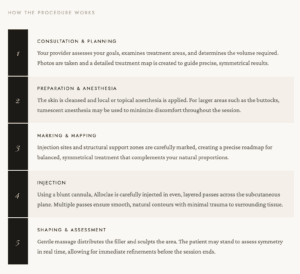
The “See, Plan, Treat” protocol used during Alloclae procedures gives providers a structured framework for precisely targeting treatment areas. Using a blunt cannula, the filler is distributed in small, even droplets across subcutaneous or intramuscular planes — similar to the technique used in autologous fat grafting, but without the prerequisite of harvesting donor fat from the patient first.
Alloclae has demonstrated particular versatility across treatment areas: breast enhancement and contouring, hip dip correction, buttock reshaping, thigh and calf augmentation, scar and contour irregularity correction, and off-label facial applications in carefully selected cases. It’s an especially compelling option for lean patients on GLP-1 medications who lack sufficient donor fat for traditional grafting.
Benefits and Risks of Alloclae Procedures
Like any medical procedure, Alloclae comes with a meaningful set of advantages as well as important limitations and risks. Understanding both sides clearly is essential to making an informed decision — and something we always walk through in depth during your consultation.

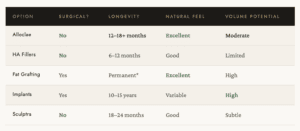
How Alloclae compares to the alternatives is a question worth examining carefully. It sits in a distinct position in the treatment landscape — more natural and longer-lasting than hyaluronic acid fillers, less invasive and more accessible than autologous fat grafting, and far less dramatic in volume potential than implants. For patients seeking elegant, moderate contouring, this middle ground is precisely what makes it compelling.
Your Questions, Answered
Frequently Asked Questions About Alloclae
How does Alloclae compare to synthetic fillers?
Alloclae is made from real human adipose tissue, not synthetic materials. It retains collagen and growth factors that support smoother tissue integration and more natural, longer-lasting outcomes than hyaluronic acid or calcium hydroxylapatite fillers.
Is Alloclae a good option if I previously had surgery or fat grafting?
Yes. Alloclae can improve the appearance of prior procedures by correcting volume deficits, refining asymmetries, and filling contour irregularities left by previous surgery or aggressive liposuction.
Is Alloclae safe for patients with autoimmune conditions?
In many cases, yes — but a detailed review of your health history and current medications is essential before proceeding. We evaluate each patient individually to confirm safety and candidacy.
Can I combine Alloclae with other treatments?
Absolutely. Depending on your goals, Alloclae may be combined with energy-based therapies such as laser, radiofrequency, or ultrasound treatments. Your provider will design a safe, staged timeline for optimal results.
Is Alloclae FDA-approved?
Alloclae complies with tissue bank regulations and is terminally sterilized to FDA standards for human tissue products. Its specific application as an aesthetic adipose filler is not yet FDA-approved, but it follows strict industry standards for safety and sterility.
Is there an age limit for Alloclae?
Alloclae is typically available to adults 18 and older, with no established upper age limit. Candidacy is determined by skin quality, overall health, and the specific goals of treatment rather than age alone.
Is Alloclae Right for You?
Alloclae represents a genuine inflection point in the evolution of body contouring. For the right patient — someone near their ideal weight, seeking elegant, natural enhancement without surgery, who either lacks sufficient donor fat or simply prefers to avoid the liposuction process — it offers something that simply didn’t exist before: meaningful, lasting volume from a biologic filler, delivered in an office setting with minimal downtime.
It is not a replacement for fat grafting in patients who need significant augmentation, nor is it a substitute for implants in those seeking dramatic size changes. But for the growing population of patients who fall between those extremes — who want refinement, not reconstruction — Alloclae is a compelling and increasingly well-supported option.
As with any emerging technology, informed decision-making is everything. Long-term clinical data continues to accumulate, and the early reports from board-certified surgeons across the country have been overwhelmingly positive. At Dr. Dana MD, we evaluate every patient individually, explain every option with full transparency, and never recommend a procedure unless it is genuinely the right fit for your anatomy, goals, and lifestyle.
If you’re curious whether Alloclae could be part of your treatment plan, we’d love to have that conversation. A consultation with our team is the first step.
This article is for informational and educational purposes only and does not constitute medical advice. Alloclae is regulated as a human cell, tissue, and cellular and tissue-based product (HCT/P) and is not FDA-approved for aesthetic use. Consult a board-certified plastic surgeon to evaluate your individual candidacy, goals, and health history before pursuing any aesthetic procedure.
Explore What Alloclae
Could Do for You
Our consultations are comprehensive, unhurried, and built around your goals. Let’s talk about whether Alloclae is the right fit for your body and your vision.
(561) 257-4100 · www.drdanamd.com · Serving Palm Beach, West Palm Beach & South Florida