

How much does a labiaplasty cost
In the past, labiaplasty or labiaplastia and vaginal rejuvenation surgery have been treated as taboo subjects — but that is changing. You shouldn’t feel embarrassed about understanding your own body. Many women are unsure about what the different parts of the vulva do or what is considered “normal.” Women should feel free to embrace their bodies and feel confident in their own skin. Labiaplasty surgery is more common than every, and labiaplasty surgery cost is typically lower than you might think.
Can insurance cover labiaplasty? The short answer is that it is highly unlikely since insurance companies see the procedure as being purely cosmetic most of the time.
To start, there is a wide range of “normal” — just like every face is unique. That said, some women notice that what they see or feel is different from how things used to be, or different from other women, and they want to know if it can be changed. It is quite common for women to want to understand how we shrink labia minora skin with surgery. Let’s explore the anatomy of the vagina, what it does, and what options are available to help you feel your best.
ANATOMY OF THE VULVA
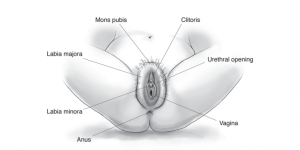
Technically, the vagina refers only to the vaginal canal inside the body — but the entire female genitalia is often called “the vagina.” All the parts visible externally are called the vulva. The internal genitalia refers to the vaginal canal, which runs from the vulva to the cervix (the entrance to the uterus).
CLITORIS
The clitoris is a pea-sized organ at the top of the vulva. It is highly sensitive and contains more nerve endings — approximately 8,000 — than any other part of the body. It is one of the primary sources of sexual pleasure when touched or stimulated.
Some women feel that excess skin around the top or sides of the clitoris affects their comfort, self-esteem, or sexual satisfaction. Clitoral hood reduction can address this excess tissue. Despite the common fear that sensation will be reduced, this almost never happens — the nerves to the clitoris originate from directly underneath it, meaning tissue above and along the sides can be safely removed by a trained, experienced surgeon.
Clitoral hood reduction can be performed under local anesthesia in the office for approximately $2,000. Excess tissue is removed and the edges are closed with absorbable sutures. Most patients take 4–5 days off work and resume sexual activity after 4–6 weeks.
Clitoris reduction or pexy (lift) may be appropriate when the clitoris itself is enlarged or protruding, though this is a more complex procedure with a higher risk of sensation changes.
URETHRA
The urethra is the tube that transports urine from the bladder out of the body. After childbirth or with age, some women experience urinary incontinence. When leakage is severe or associated with bladder prolapse, surgery is often necessary. For women with mild incontinence, however, our FemTouch vaginal laser can gently tighten the surrounding tissue and improve symptoms.
FemTouch is performed in-office and typically costs $1,000–$1,500 per treatment. Most patients experience no discomfort and only 2–3 days of light restrictions. The protocol consists of 3 treatments spaced 4–6 weeks apart, with annual maintenance sessions to sustain results. Many patients notice meaningful improvement after even one session.
LABIA MAJORA
The labia majora are the outer folds of skin that form the boundary of the vulva and protect the more sensitive internal structures. Some women notice changes to the labia majora after weight loss, pregnancy, or with age.
Labia majora reduction can help women who are unhappy with the appearance in tight clothing, bathing suits, or in the nude. Some patients also seek relief from recurrent irritation or yeast infections caused by excess tissue.
Reduction is typically performed in-office. Tissue is removed from the inner portion of the labia majora through an incision hidden between the labia minora and labia majora. Cost is approximately $6,000 for an in-office procedure. Most patients return to work in 2–4 days, resume exercise in 2–4 weeks, and resume intercourse in 4–6 weeks.
In some cases, what appears to be excess labia majora is actually caused by excess tissue at the mons pubis. A tummy tuck or mons lift may be a more appropriate solution in those cases.
For women who instead notice a deflated or volume-depleted appearance, fat transfer or dermal fillers can restore fullness. Laser or ultrasound skin tightening can also smooth and tighten the tissue with less downtime, though results typically require annual maintenance.
LABIA MINORA
The labia minora are the inner lips of the vulva, running from the base of the vaginal opening up toward the clitoris. They protect the more delicate internal structures and can change in size and color depending on hormonal fluctuations.
Many women find that enlarged or asymmetric labia minora cause discomfort in tight clothing or bathing suits, or affect confidence and comfort during intercourse. Labiaplasty — surgical reduction of the labia minora — can be performed in-office using numbing cream and local anesthesia for approximately $4,000–$6,000. Sutures dissolve on their own, most patients return to work within a few days, and sexual activity can typically resume after 4–6 weeks.
There is a small risk of temporary hypersensitivity and, more rarely, decreased sensitivity. Most patients are pleasantly surprised to find that at around three months post-procedure, scarring is minimal and the results look entirely natural.
THE VAGINAL CANAL
The tightness of the vaginal canal can decrease after childbirth or with age. Vaginal dryness and irritation are also common, particularly after menopause — both of which can reduce sexual satisfaction for both partners.
For significant vaginal laxity, vaginoplasty — surgical vaginal tightening — is the most effective treatment. Performed under general anesthesia, it costs approximately $9,000-$13,000. Excess vaginal lining (mucosa) is removed, the muscles are tightened with absorbable sutures, and the lining is repaired. Heavy lifting and sexual activity should be avoided for approximately 8 weeks.
For women with mild laxity, dryness, or incontinence, our FemTouch CO2 laser treatment is a highly effective non-surgical option. Costs typically range from $900–$1,900. Most patients have no discomfort and only 2–4 days of light restrictions, with 3 treatments spaced 6 weeks apart and annual maintenance to sustain results.
For non-invasive thermal tightening, TempSure Vitalia uses radiofrequency energy to improve vaginal tissue laxity and comfort with virtually no downtime.
THE PERINEUM
The perineum is the area of tissue between the vaginal opening and the rectum — the muscle group engaged during Kegel exercises. After childbirth, some women lose muscle tone or thickness in this area.
Laser and radiofrequency treatments can address mild perineal laxity, but many patients are better served by a surgical procedure to restore muscle tone. Downtime is similar to vaginoplasty. For women who don’t have muscle weakness but are bothered by changes in appearance following an episiotomy or childbirth tear, removal of excess perineal skin can provide significant improvement, with downtime more similar to labia surgery.
THE MONS
The mons pubis is the area of soft tissue over the pubic bone. While not technically part of the genitalia, many women seek improvement in this area after weight loss, pregnancy, or with age.
When excess fat is the primary concern with no extra skin, liposuction can reduce the size of the area through incisions less than ½ inch, hidden by underwear. When excess skin is also present, skin removal can be combined with liposuction. These procedures can be performed in-office or in the OR depending on patient preference, with costs ranging from $6,000–$9,000 and minimal downtime for most patients.
DO I NEED SURGERY?
Because there is such a wide range of “normal,” very few women medically require surgery to improve comfort or reduce skin infections. However, many women choose surgery to feel more confident in their appearance and more comfortable during exercise or intimacy. If you are considering any of these procedures, the most important step is to consult with a board-certified plastic surgeon who is experienced in multiple vaginal rejuvenation techniques and specializes in female genital aesthetics.
Contact Dr. Dana MD in Jupiter, Florida to schedule your private, judgment-free consultation today.